Showing posts sorted by relevance for query hooked. Sort by date Show all posts

Monday, March 17, 2014

Review, news, and other potpourri...


Hi folks,

Got the following from the newsletter of my friend and fellow writer, Mike Klaassen and thought I’d share with you. At the end, is Mike’s contact info for his (free) newsletter which is always chockfull of good writing advice, reviews, and tidbits. Tell him I sentcha!

Book Review
HOOKED: Write Fiction That Grabs Readers at Page One and Never Lets Them Go
By Les Edgerton
Writer’s Digest Books, 2007

Hooked is the book about beginnings.

Books about fiction-writing tend to fall into one of three categories: 
  • A-Z books, which address a wide spectrum of fiction-writing issues
  • Quasi-biographical books, which are as much about the author as they are about writing
  • Narrow-focus books, which take an in-depth look at a specific aspect of fiction-writing 

Hooked, by Les Edgerton, focuses on one aspect of fiction-writing: beginnings.  In general, readers should expect a narrow-focus book to:
  • Adequately address its topic of focus, compiling and reorganizing the body of existing information
  • Debunk misinformation and out-of-date practices about the topic
  • Offer new ideas and insight about the topic
Les Edgerton has accomplished all of these in Hooked. 

Why a whole book about beginnings?  As explained by Edgerton, “The simple truth is, if your beginning doesn’t do the job it needs to, the rest of the story most likely won’t be read by the agent or editor or publisher you submit it to.”

Edgerton addresses misinformation and out-of-date practices from a historical perspective and as they relate to literary fiction.  Whenever an author sheds new light on a subject, there is a risk that someone will be offended: no exception here.  Writers, of any genre, in the habit of beginning stories with hefty servings of backstory or description get an earful. 

Those who believe that studying the classics is the key to understanding fiction may be turned off by Edgerton’s take on beginnings: “. . . many of the great books from the past aren’t practical structure models for today’s market, particularly in the way some of those books begin.”  And, “Beginnings have changed more than any other part of story structure.”

Likewise, fans of literary fiction may take exception to some of Edgerton’s observations.  “Bookscan has revealed the decline of what is usually referred to as literary fiction.  This category of fiction may be dying because it has stuck with the story structure model of yesteryear much more so than any other category.”

Hooked is organized into eleven chapters:
  • Story structure and scene
  • Opening scenes
  • Inciting incident, initial surface problem, story-worthy problem
  • Setup and backstory
  • Combining inciting incident, story-worthy problem, initial surface problem, setup, and backstory
  • Introducing characters
  • Foreshadowing, language, and setting
  • Opening lines
  • Red flags
  • Opening scene length and transitions
  • View from the agent’s and editor’s chair

The last chapter is structured as questions and answers from agents and publishers.  For example, from agent Jodie Rhodes: “ . . . the more modest the writer, the better the writing.  That’s because good writers know how much they still have to learn.”

Hooked is a must for the bookshelf of serious students of fiction.

http://www.amazon.com/Hooked-Write-Fiction-Grabs-Readers-ebook/dp/B0033ZAVV2/ref=sr_1_1?ie=UTF8&qid=1395068494&sr=8-1&keywords=les+edgerton+hooked


SUMMARIZATION: A fairly maligned fiction-writing mode
By Mike Klaassen

Should you always "show" rather than "tell?" Summarization is the fiction-writing mode whereby story events are recapped. In summary mode events are told rather than shown. Action mode shows an event in detail as it happens, summarization tells about it. The old writing axiom "Show. Don't tell." implies that summarization is inferior writing, to be discouraged. This is unfortunate because telling, in the form of summarization, has a vital role.
Any event may be portrayed either in the action mode or in summarization. Consider the following gunfight in action mode:
As the sun reached its zenith, Cisco strode onto the dust-filled street and faced Black Bart. Without warning, Bart reached for his pistol. Cisco dived to the right as Bart fired. Cisco rolled in the dirt and drew his Peacemaker. He fanned his hand across the Colt’s hammer in rapid succession, sending three slugs into Bart’s chest.

The same event may be summarized as:
At noon, Cisco faced Black Bart and gunned him down in the street.

Summary mode has many applications. It may be used to: (1) report an event that doesn't warrant the detailed, as-it-happens treatment of the action mode, (2) shift from one time or location to another, (3) setup a writing passage by "catching up" the reader on what has happened since the previous scene, sequel, chapter, or section or (4) vary rhythm, pace, tone, or texture.[i]

REPORTING EVENTS
Summary mode is appropriate for reporting events that don't warrant detailed, real-time presentation. As fiction writers we make many decisions. We choose which events to report and which to leave out. We choose which events to report in detail and which to summarize. For example, depending upon the objectives of the author, the summary of the gunfight described above may be appropriate. Readers may need to know that event occurred but don't need to know the details. Telling lets the reader speed past less important action. If fiction were a video player, action would be accessed with the "Play" button, and summarization would be the "Fast Forward" button, where events are skimmed over.
Summarization may be particularly appropriate when there is repetition of events.[ii] For example, if Black Bart was one of five gunfights Cisco had that day, showing each of these events in action mode could become tedious for the reader.

SHIFTING TIME OR LOCATION
Summarization provides an opportunity to telescope time and shift locations. Rather than showing all the details in an uninteresting journey, the writer might summarize it. For example:
Over the next three hours as the storm continued, they followed the winding path around and over one dark hill after another.
Like a time machine fitted with a global-positioning device, summarization can transport the character across time and space.

SETTING UP A NEW PASSAGE OR VIEWPOINT CHARACTER
Summarization may be used to set up a new scene, sequel, chapter, or section—even a change in a viewpoint character. This may be accomplished at the beginning of the new passage simply by naming the new viewpoint character and describing what he is doing, thinking, or feeling. For example:
Fortney reached the top of the hill and stopped. Before him, as far as he could see, stretched rolling, grass-covered hills.

VARYING RHYTHM, PACE, TONE, OR TEXTURE
Summarization and action, even when used to describe the same event, have a different pace, rhythm, tone, and texture (Just think of the gunfight described above). The decision to use one versus the other becomes a tool for manipulating the story. For example, imagine a medieval battle with knights engaged in a series of sword fights. The writer might decide to describe the first fight in action mode, summarize the next three (Over the next hour Arthur dispatched three more dark knights.), and then show the climatic fight in gory detail.

As with each of the other ten fiction-writing modes, summarization has both advantages and disadvantages. Action involves the reader and is intimate and immediate, but too much action can fatigue the reader. Summarization distances the reader and lacks immediacy. Summarization offers one distinct advantage over the action mode, and that is brevity.[iii]
Summarization deserves respect as a fiction-writing mode. Without summarization, fiction could be tedious and disjointed. For any particular passage of fiction, the challenge is to show when appropriate and to tell when appropriate.


ABOUT MIKE
 
Mike Klaassen is the author of two young-adult novels: The Brute and Cracks. He has also written numerous articles about the craft of writing fiction. His current projects include a novel set during the War of 1812 and a nonfiction book about the craft of writing fiction.  

Mike and his wife, Carol, lived in the Wichita, Kansas area while raising their two sons. After fighting cancer for four years, Carol died in 2012.

Mike and Carol were good friends for twenty-five years with another couple, Michael and Gerri. Throughout those years Michael had multiple sclerosis, which became increasingly debilitating. Michael died one month before Carol. After each being married to a wonderful spouse for thirty-five years, Mike and Gerri are happily engaged.
 
            
You can learn more about Mike and his novels at www.mikeklaassen.com 

Mike Klaassen
P.O.Box 4781
Wichita, KS 67204-0781
(316) 744-4325

SUBSCRIBE NOW

If you have enjoyed this newsletter and are not already receiving it automatically each month, you are welcome to a free subscription.  Just click on the "Join Our Mailing List" button at the top of this page (also available at www.mikeklaassen.com).  Or if you prefer, send an email to mike@klaassen.kscoxmail.com and ask to be added to Mike's ezine list. 


Thanks, Mike. Well, in a couple of days, my son Mike and I are jumping on a plane to go spend a week at my best friend Tom Rough's place in Cave Creek, AZ, and are going to see our beloved Giants WHIP UP on the Oakland A's in a spring training game in Scottsdale. Can't wait to be someplace where I'm not staring at six-foot-high snow drifts...
 
And, on a bit of a downer, The Rapist didn't win in the BigAl's recent contest. But, thank everybody for coming out and voting--I appreciate it! I'll try to do better next time...


Blue skies,
Les

Wednesday, November 15, 2017

COUPLE OF BLURBS...

Hi folks,

I'm pleased to present a couple of blurbs today--one for a writer I admire very much and another which was given to one of my books.

The first is what I wrote about Earl Javorsky's newest novel, DOWN TO NO GOOD. Here's what I have to say about this terrific book:

ORDER HERE


Blurb for Earl Javorsky’s DOWN TO NO GOOD

Hand me a book with a P.I. who’s been shot in the head and come back from the dead, along with a psychic who solves crimes right and left, along with some other folks who are more than a bit irregular and I’m unplugging the TV, turning off the alarm clock, and hiding my phone under a pillow where I can’t hear it. I just emerged from an all-night sesh with DOWN TO NO GOOD, a volatile mess of pages littered with the madness that Earl Javorsky’s fevered brain manufacturers. I’m going to the nearest mental hospital and turn myself in and hope for some good drugs. It was worth it, though.

Les Edgerton, author of THE RAPIST, THE BITCH, THE GENUINE, IMITATION, PLASTIC KIDNAPPING, JUST LIKE THAT and others.

And, then I received the following blurb from mega bestselling author Jerry Jenkins. Jerry had asked me to record a video for his writing classes on Hooked and I agreed immediately. We plan to record at least a couple more next year. He sent me the following blurb to be used for HOOKED:


Jerry Jenkins blurb for HOOKED

I read every writing book that comes down the pike, and I like a lot of them. But I LOVE Hooked / write fiction that grabs readers at page one and never lets them go! As punchy as Les Edgerton’s hard-hitting fiction, Hooked takes no prisoners. Clear, simple, direct, it offers something fresh in every chapter. I recommend it to all my students and even my colleagues. Your writing library won’t be complete without it.

Jerry Jenkins
Novelist & Biographer
The Jerry Jenkins Writers Guild
Best-selling author of the Left Behind series and many others 

That's all, folks!

Blue skies,
Les


Thursday, November 1, 2018

NEW REVIEW OF HOOKED

Hi folks,

A new review of my craft book, HOOKED, has just appeared on European author Damien Seaman's blog. Here is how it appeared:


How to write better, faster and more successfully

How to get publishers to *really* read your book
IN-DEPTH REVIEW: Hooked: Write Fiction That Grabs Readers From Page One And Never Lets Them Go, by Les Edgerton


Click here


I won’t mince words.
Hooked! is a writing guide you need to own if you are serious about your fiction writing.
What do I mean by serious?
Well, the book sets out to help you write something “publishable” and is very clear about what that means in terms of story structure.
So, serious means if you want to get a publishing deal (or a good agent to represent you).
Or if you want to sell more self-published books – because what publishers want is dictated by what readers seem to want.
Either way, this book is for you.
Author Les Edgerton has published 20 books plus innumerable short stories and magazine articles during his career. He has also taught creative writing, and been nominated for several awards for his fiction.
He has a good idea of what sells, in other words.
How to write a sellable manuscript to a quality press
Although here I introduce a note of caution.
Les is not a huge bestseller, and he does not teach how to write the doorstep blockbuster novels you buy in airport bookstores. He knows how to write a sellable manuscript to what he calls a “quality press”.
He’s also very clear that the technical limitations of what publishers will buy are strict.
“Novels and short stories, no matter how complex their plots may appear, are almost always based on a simple underlying structure: A character begins in stability in his world; this word becomes unstable after the introduction of an inciting incident; the character struggles to restore his stability; and a new stability is established at the conclusion,” Edgerton writes.
So far, so uncontroversial. At least to most of us. But then Edgerton continues:
“What is different about today’s story structure is that the first part of the equation – stability – has been shortened considerably and, in many cases, completely omitted.”
In other words, this book is a master class on story structure as expressed through the microcosm of a book’s opening.
Readers – and publishers – want to be hooked from the very first line, Edgerton explains. They want an opening that grabs them and pulls them through the book.
What an inciting incident is – and how to get it right
So, we get a lot here about the importance of the inciting incident – what it is and how to use it properly.
This is essential reading. Also essential to read more than once. Why? Because it’s actually pretty hard to grasp in practice. Or, at least, I’ve found it to be so.
It’s a concept that seems laughably simple. Until you try to apply it to your own work and you realise you have a certain blindness – or lack of ruthlessness – about what an inciting incident really is, and whether or not your book has one.
As a result of this, Les asserts that a great many books start in the “wrong place”. Indeed, he has said this to me about one of my books – one that was previously published.
So believe me when I say this is essential knowledge and essential to apply over and over until you are utterly confident that you get it.
A lot of tricky concepts, each one explained with practical examples
From the inciting incident idea, Edgerton takes through related concepts:
·         Story-worthy problems – what they are, how to come up with them and how to write them into your manuscript
·         Surface problems – how they differ from story-worthy problems, and why, and how to juggle the two
·         How these problems relate to your character – and to your reader
·         Setup and backstory – how much the modern manuscript should contain, plus exceptions to the rule
·         How to combine the inciting incident, story-worthy problem, initial surface problem, setup and backstory in a way that seems natural and engages your reader
As you can see, there’s a lot to take in. Which is why it’s not just worth buying this, but reading through multiple times and then applying to your work in progress as soon as you can.
I speak from recent experience, as at the time of writing Les has been eviscerating a story opening of mine. And I thought I knew this stuff!
As I said, this is a book for writers who are serious about improving their craft. But not just that. It’s for writers at all levels of experience.
I’ve published two novels with two different small publishers and there’s material in here that I only now realise I didn’t grasp as thoroughly as I thought I did.
I would wager it’s the same for you.
Read this book at least twice if you’re serious about your writing
In summary, buy this book. Read it at least twice. First time for pleasure. Second time, make notes. As many as you need to. Ask questions. Read it a third time to look for the answers to your questions.
Now apply it to what you’re working on. And go back through the book with your specific work in progress in mind.
That’s how important and how useful this book is. Also how important it is that you fully understand how to apply it.
Anyway, do make sure you buy it. I cannot recommend it highly enough. And, once you’ve read it, nor will you. Be able to recommend highly enough, I mean.
You’ll see.
Also, come back to the blog next week for my two-part interview with Les, and my in-depth analysis of his fantastic memoir, Adrenaline Junkie. 


Thanks, Damien!

Blue skies,
Les

Friday, September 10, 2010

A MAJOR FLAW IN TEACHING CREATIVE WRITING (FICTION) EFFECTIVELY LIES IN OUR TERMINOLOGY

What we say ain’t always what we mean…


I read a lot of blogs from other writers, agents, editors and other professionals in the writing game, and I read a lot of letters from writers responding to those posts. Alas, again and again, I see some general misconceptions about writing techniques and story structure that I’d like to address.

I see the same misconceptions from my students in my online classes and from clients I work with.

The misconceptions seem to arrive from misunderstanding the definitions of the terms we employ in describing fiction writing and fiction techniques.

I’ve come to believe that much of the misunderstandings writers have stem from the fact that many of our terms are lay terms, and while the definitions assigned certain terms have their root in “lay” or “dictionary” definitions, there are significant differences when applied to writing, and it is these differences that cause a certain amount of confusion.

That sounds like a lot of goobly-gook, doesn’t it? Sorry! I’ll try to explain better.

A good example of what I’m talking about that I’ve seen a lot written about lately refers to the term “action” in fiction. A non-writer usually thinks of action in reference to drama—books, movies, plays, and television—as some kind of physical activity. Many times, the word evokes images of melodrama—bombings, kidnappings, shootings, stabbings, beatings, rapes… violent physical action, in other words. Lots of noise, screams, smoke, and fury. Writers need to think differently and understand that action in fiction means something much more than in real life.

I just read a letter on another blog from a beginning writer who complained that she began her novel with “action”—in her case, an armed robbery involving her protagonist—and then couldn’t figure out why this didn’t “hook” the reader, i.e., the agent, she’d sent it to. She said he turned her mss down because while the robbery hooked him in the very beginning, it turned out to be mostly unrelated to the story that followed. This poor writer had done what a lot of writers seem to do. She thought that when teachers, agents and editors said they wanted to be “hooked” immediately on the first page, they were looking for something along the lines of that lay definition of action. A gun going off or whatever.

Not.

The term “action” when applied to fiction means something vastly broader and more encompassing of other activities than the stuff listed above. While it can include those kinds of activities, literary action also encompasses many other things. Dialog is action, for instance. A character driving down the road and seeing a dead plover is also action. A character reading a newspaper on the subway is action. Anything a character is doing is… action.

This one misunderstood term is to blame for many of the mistakes made in creating a manuscript, especially when trying to follow the advice of the pros.

I regularly get very nice letters from folks who’ve read my book on story beginnings (Hooked) who reveal, by their questions that they’ve fallen prey to that misconception of the word “action.” Statements like this are not atypical: “I know I’m supposed to start with action, but the story I want to write isn’t high-concept and is more of a character study. I can’t have my protagonist, Irma, getting raped. Nothing like that would ever happen to her. I know in your book you say the story has to open with action, but I don’t see how I can do that here. Should I write another story?”

That’s a made-up statement, but it’s accurate inasfar as the gist of some of the letters I receive. And, it’s reflective of a couple of things. One, a misunderstanding of the term action, and, two; a sure sign of selective reading. That’s fairly common, I’ve found. I’m probably guilty of the same myself.

To address the first, I’ve tried to make it clear in Hooked, the writer’s definition of action. I’ve given a number of examples of openings that illustrated forms of action that didn’t involve any guns, sexual attacks, bombs or any of that. For instance, one of the examples I used was of James Baldwin’s story, Sonny’s Blues, which begins with the “action” of the protagonist sitting on the subway reading a newspaper where he sees an account of his brother’s arrest. That’s “action” according to the literary definition. Another, where I described the opening of Tim Sandlin’s novel, Sorrow Floats, which begins:

            My behavior slipped after Daddy died and went to San Francisco. I danced in bars. I flipped the bird in churches. Early one morning in April I drove Dothan’s new pickup truck off the Snake River dike, and when the tow truck showed up they found me squatting in a snow patch in my nightgown crying over the body of a dead plover.

That’s beginning with action. The action is her crying over the dead bird. It’s not even her driving the truck off the dike. The action is simply her seeing this bird and weeping. (The other part of that is just backstory and setup). Seeing the dead bird is her inciting incident and it satisfies all the requirements of a good inciting incident and begins with action. Seeing a dead bird makes her realize what she’s been running away from and it’s from that point that the story begins.

And… it’s action.

I won’t go through the dozens of openings I used for illustration in Hooked, but nary a one begins with a gun going off or someone being raped or a President poised with finger on the red button. But, without exception, they all began with action. Action, according to the literary usage of the term, not the lay definition.

It is so crucial to understanding how stories are written successfully to fully grasp the definition of the term “action,” yet time after time, it’s obvious by the conversation that the student is thinking of the lay definition in his or her application and thought process.

To address the second point, many readers read selectively; that is, some of what they read becomes invisible to them and they "read" only the parts that appeal to them. I know I've defined action over and over in my books on writing, and still, I communicate with writers who say they've read the books, but still don't remember reading the parts where I showed other kinds of action. At least that's what it appears is happening. I think what happens is that sometimes some folks just don't read carefully. Wish I could say I'm not guilty of doing that, but I surely am and often. If anyone has a cure, please pass it on!

What happens is that the teacher and the writing student are trying to have a dialog that’s doomed to failure simply because they’re not on the same page as far as the definitions of the terms we employ. We’re close… but close doesn’t count in writing. Our chief tools as writers are words and they need to be precise. Clear and understandable. Unfortunately, our craft terms are perhaps the worst of any craft in existence and the opposite should be true. Instead of clearly defined, they are often murky and vague.

For another common example of a misconception in writing terms, let’s look at the term “problem.” A problem in lay terms can mean something like the person is being divorced. Is that a problem in “real life?” Well, usually. But, in terms of describing a protagonist’s problem for story, by itself, it doesn’t rise to the level of a story problem. It’s merely a bad situation. And, bad situations do not literature make. They can—but there has to be more to it than simply a bad situation. Any one of these things for example—a rape, a murder, a kidnapping, a divorce, a partner’s cheating, a person declaring bankruptcy, a bully giving wedgies to a skinny kid—any of those instances are great examples of “problems” in real life, but without more they aren’t in literature. They’re simply… bad situations. Good for anecdotes, but not yet for stories.

For something to be a problem in literary terms it has to represent a profound change in the protagonist’s life—signaling a change in the person’s life before the problem to what it is after the problem makes its appearance. It has to rise to the level that nothing can interfere with his or her struggle to resolve the problem until it’s finally resolved. If, for instance, the character can take time off for other things even briefly—then it hasn’t yet achieved the status of story problem. This is what happens often when writers believe their character’s inciting incident began in childhood (the inciting incident being the event that created and/or revealed the problem) and then they have the kid “take off” the next seven years so they can get old enough to tackle the problem. Might work in real life, but it’s just not a problem yet in story terms. It’s a… bad situation. If anything can get in the way of, distract, or cause it to be put on the shelf for any period of time whatsoever… it’s just not a problem in literary terms.

Also, the story problem has to have two levels. The initial problem is what I’ve created the term “surface problem” for. That’s what seems to be the problem at the onset of the story. Surface problems can be anything. But, they all have to be symptomatic of a deeper, more personal, psychological problem, to which I’ve created the term “story-worthy problem.” The surface problem is simply kind of the “material” manifestation of the story-worthy problem.

For example, in the movie Indiana Jones, Indiana’s surface problem is to win his father’s respect. To do this, he feels he has to find the Holy Grail. His surface goal which he feels will resolve his surface problem. But, his story-worthy problem is his lack of self-respect. In a story, the protagonist has to go through the struggle to resolve the surface problem to finally realize (as a result of the struggle) what his true (story-worthy) problem is.

In the movie, Thelma & Louise, protagonist Thelma’s surface problem is to escape her overbearing husband briefly. Her story-worthy problem—which she can only discover after going through her struggle—is to escape a male-dominated world in which she has little voice.

In David Madden’s novel, The Suicide’s Wife, the protagonist’s problem is that her husband has (supposedly) committed suicide and left her unprepared to face life’s everyday demands. Her surface goal to resolve this is to obtain her driver’s license. Her real story-worthy problem is to find out if she has the internal wherewithal to exist independently. The struggle she undergoes to resolve her story problem leads her to understand what that problem is symptomatic of and therefore gives her the capability to resolve the deeper problem.

In almost all instances, both the surface problem and the story-worthy problem are resolved in the last and final scene. When s(he) resolves the other one, at that point s(he) understands the underlying problem at the same time and by his or her choice in that final scene also resolves that problem as well.

The point I’m trying to make here is that when we use the term “problem” in writing and story terms, we’re not talking about real-life problems. There has to be more involved to make it rise to the level of a good story problem than just a bad situation. Problem as applied to story is something far more than a problem in real life.

There are many such terms we use as writing teachers that we’ve borrowed from the lay language, and because students and beginning writers very often ascribe those lay definitions to the terms, we have a problem communicating with each other and fully understanding and grasping the advice given We’re close… but close just ain’t good enough.

I’ve often thought that there is a great need for a text on this. It’s presumptuous, I suppose, for one person to think he or she can create a lexicon that all writers should follow, but somebody needs to do this. Right? Okay. I’m on it…

Anyway, I hope this helps a bit to “unmuddy” the waters…

Blue skies,
Les

Friday, September 23, 2022

JAPANESE VERSION OF HOOKED

 Hi folks,


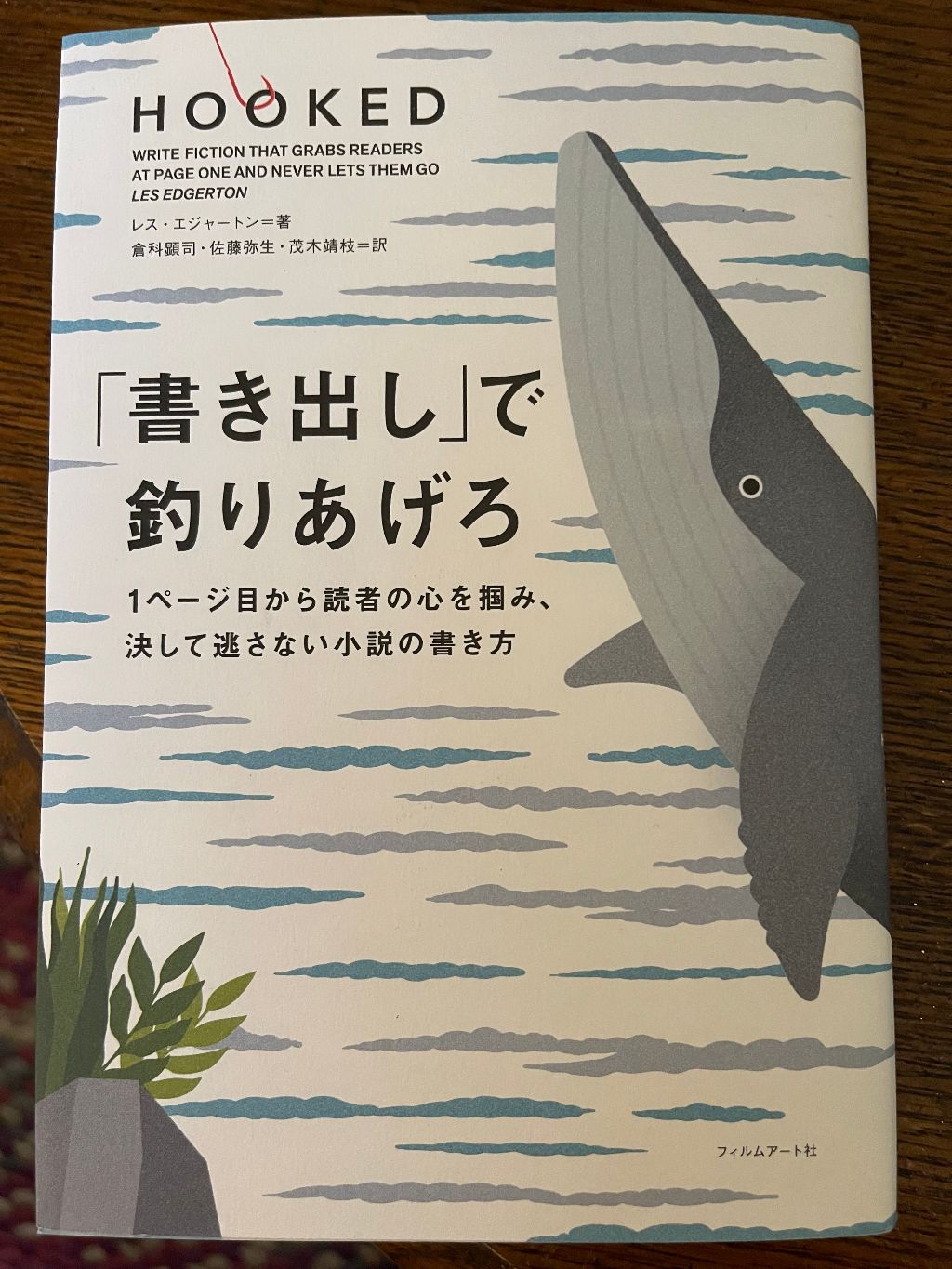
Finally got my copy of the Japanese version of Hooked. They made a beautiful book!


Japanese publisher Film Art, Inc. is the publisher. Out of the blue one day, I got an email from a former agent of mine that they'd contacted him and wanted to purchase the Japanese rights to Hooked. He hadn't been my agent on it, so he got in touch with me and they made me a very generous offer of a $2,500 advance against royalties, which I happily took. It's rare for a book to sell foreign rights after it's been out 17 years, but Hooked has been mighty kind to me. I still get substantial royalties each year from Penguin who own the U.S. rights after Writer's Digest went bankrupt.

Film Art, Inc. came out with an initial run of 3,000 copies. Please tell all of your Japanese writer friends they can now buy it in their native language!


And, here's the original!

Blue skies,
Les


Tuesday, June 6, 2017

Smart, funny, tension-filled new novel!

Hi folks,

Many of you here know Kristen Lamb the wise guru of social media. She’s now set her hand to writing fiction and recently came out with her rookie effort, a thriller titled THE DEVIL’S DANCE.

Click on the cover to go to the Amazon link.

The book that Kristen gives way too much credit for...
what a cynic might call a "humble/brag"

Me and Kristen at the DFW  Writer's Convention


She asked me to blurb it and I agreed because… well, just because you don’t say no to Ms Lamb. When I sent her my blurb, I got this email from her:


OMG thank you!

This is beautiful and I need to frame it! You have no idea. I bought your book (HOOKED) early 2008. I immediately made everyone in my writing group get it (though I think i was the only one who read it). My mom loves it and she isn't even a writer. I have easily read it six times and get something new every time.

And then misplace it and buy another copy.

Anyway, so I had this imaginary bar set in my mind that ONE DAY. ONE DAY I'd write something you'd be proud of even before I met you! That you'd go, THAT is why I wrote "Hooked."

Seriously, I need to send you the first pages of the novel I was shopping when I came across "Hooked"...except I like you and that manuscript is not potty trained.

Getting a blurb from you for "Rise of the Machines" was a big deal but NOTHING like this.
Kristen


Her book is kind of a big deal for me because a first novel isn’t usually this good. It’s a remarkable piece of work. It just goes to prove that anyone with talent (many) and perseverance (rare) and the ability to take constructive criticism (very rare!) can create a publishable book.

If you saw the first draft of what Kristen sent me a couple of years ago and compared it to what she ended up with, you’d easily see the veracity of that last sentence.

Here’s my blurb:

Blurb for Kristen Lamb’s novel, THE DEVIL’S DANCE

I picked up Kristen Lamb’s debut novel, THE DEVIL’S DANCE, fully expecting to be reading what I anticipated as a decent first effort at fiction—and was instantly dissuaded of that notion—finding instead totally mesmerized by a book of the quality normally reserved for those best-selling, rave review-garnering, masters of thriller novels. I was totally gobsmacked. Lamb has crafted a work of immense worth. It’s truly remarkable in its maturity, level of writing, and most important, level of entertainment. We often see reviews where they trot out that hoariest of clichés—“It was so good I couldn’t put it down,” except in this case that’s not even close to an exaggeration, but the honest damned truth. Be assured this is no “beginner’s first effort.” This is leagues above that. Already, I’ve placed it on the shelf of “Best Books of the Year That I’ve Read.” It most certainly is. I won’t give you a synopsis—that’s already done for you on the
Amazon page, but if my opinion means anything to you, I urge you to run right out and buy this novel. Lamb is just one smart cookie who doesn’t seem to fail at any enterprise she sets her hand to. Make room on your bookshelf for a writer of uncommon and rare talent.

And… what a totally entertaining book!

--Les Edgerton, author of Hooked, Finding Your Voice, The Genuine, Imitation, Plastic Kidnapping, The Death of Tarpons and others.

Get out and pick up a copy. If you like it, take a few minutes and write an Amazon and/or Goodreads review. It’s the single best thing you can do for a writer whose work you enjoy.


Blue skies,

Les