Hi folks,
Last year, I was privileged to be asked by then-president Dawn Allen to be the keynote speaker at the Oklahoma Writers Federation Inc. annual convention in Oklahoma City and this is the speech I gave. Hope you enjoy it.
Oklahoma
Writers Federation Inc. Keynote address--2015
The
Building Blocks of Story
Hi! My name is Les and
I’m an alco—oops! Wrong meeting! My name is Les Edgerton and I’m a writer. I’m
really happy to be here and to impart to all of you all of the secrets you’ll
ever need to becoming a bestselling author, one whose books all get made into
movies, where you’re asked to do cameos in the blockbuster flicks they make of
your work, and literally roll around in filthy lucre. Your books will all get
rave reviews in the NY Times. You’ll dine always at Spago’s and Elaine’s and
never again dream of going through the drive-thru at MacDonald’s. You’ll have
to block the phone numbers of all those New York publishers who are driving you
crazy calling and wanting to publish your novels. Of course, I’ve not done any
of those things personally, but don’t worry. I have the secrets and when you
leave here, you’ll have all the tools necessary to achieve fame and fortune in
the writing world.
Guaranteed.
Once you leave here,
you’ll never again need to read a craft book, attend a conference like this,
join a writer’s group, or read another novel to see how he or she does it.
You’re going to get all the secrets right here! All you have to worry about is
which island you’re going to buy to retire to…
That’s the good news.
And now, for some not-so-good news… What we like to call “the truth…” See? You
should have just drunk the Kool-Aid and gone to the bar…
First, you need to know
that not everything in writing can be taught. For instance, do you really think
that anyone could study with William Faulkner for five years and then emerge
writing as well as he could? Perhaps, but most likely not. There are some
writers who can do things that no one else in the world ever can.
Here’s a true story
that illustrates why this is. Barry Bonds was interviewed one time, and his
answer to a reporter’s question showed clearly how some things can never be
taught.
The
article:
ON AUG.
18, 2001, after it became a foregone
conclusion that Bonds would make a run at McGwire's single-season home run
record, he hit a pitch from Jason Marquis -- 94 mph, chest-high, on the fists
-- for his 54th homer. It wasn't his most memorable homer, but the physics of
it were astounding.
About two weeks later, I interviewed
him for a story in The Magazine. I asked him to take me through that 2-2
pitch: what he was thinking, what he was looking for, how he refined his swing
to be short and quick enough to get the barrel to it. He refused. He wasn't
nasty; he just felt it was a senseless exercise.
"I just have it," he said.
"I can't explain it. You either have it or you don't, and I do. People
always think there's an answer to everything, but there isn't. How can you do
that? I don't know. I just can. When people see something they've never seen
before, the first thing they say is, 'How did you do that?' The next thing is,
'Can you teach me?' The answer is no because you don't have it."
That quote, and the laugh that
followed, is the essence of Bonds. His career was played to the backdrop of
four words: You can't do this. Equal parts arrogance and truth, it
became an unspoken mantra. It's the same mentality he used to separate himself
from the game's pedestrian details. He routinely refused to show up for team
photos during his years with the Giants. He stretched with his own stretching
coach in the clubhouse rather than with his teammates on the field. He was
notoriously stingy in providing assistance to teammates, acting as if their
mundane talents were contagious. His knowledge would remain the property of the
one person who could use it best: Bonds himself.
His grandiosity knew few bounds. He
arrived at his first spring training with the Giants with a chauffeur. Replete
with black suit and tie, Dennis drove Bonds to and from the ballpark for six
weeks in February and March of 1993. It was Barry being Barry, but within the
clubhouse it was seen as a brazen act of hubris.
And the crazy thing was: He knew
better. It wasn't an inability to read the room or a mistaken belief that
teammates would understand how a man of his stature might need to display the
gilded trappings of his success. It was a calculated effort to separate himself
from the rank and file. You either have it or you don't, and I do.
(End
of article)
The same concept
applies to the truly great writers. What they do can’t be taught. That doesn’t
mean you can’t be as great or even greater than those folks were—it just means
you can’t do what they did. You may end up doing something even greater but it
won’t be what they did—it’ll be something your own peculiar genius allowed you
to do. This is not bad news—this is reality.
This is so crucial to learn. If you want to write like a
Faulkner or a Hemingway, you probably won’t be able to achieve the particular mastery
they had. Does that mean you’re doomed to mediocrity? Of course not! Bonds
couldn’t pitch like Roger Clemens no matter how good a baseball player he was.
Even though he was a good base stealer, he couldn’t steal bases the way Ricky
Henderson could. And, even though he ended up being the home run champion of
all time, he didn’t operate in a vacuum. There were hundreds of other major
leaguers playing at the same time he was and they were all successful. Just
being on a major league roster is the equivalent of being a bestselling author
in the world of literature. Raymond Carver couldn’t write what Flannery
O’Connor wrote and if she’d been alive, during his career, she probably
couldn’t write what he did. But, guess what? They’re both great short story
writers. When Hemingway wrote, there were many, many other writers who were
successful as well. The same with every other famous or great writer.
I just want to create a realistic picture for you as
writers. Many things about writing can be taught. Many other things cannot be
taught. It’s important to learn what you’re capable of learning and what can’t
realistically be taught to you. Or anyone.
I want to talk today about how to become the best writer
you can be and hopefully show you some ways to shorten the time between when
you first begin to write and when you’ve arrived as a good writer yourself.
First, if you’re
writing a novel, it’s very important to understand the building blocks of
story. There are two building blocks:
1. Scene
2. Sequel
The scene is a sequence of actions. This happened, which
led to this happening, which led to this… and so on. In a contemporary novel,
the first action that needs to appear in the narrative is the inciting
incident. This is very important. In older times, we could begin more
leisurely. We could begin with backstory or extensive setup. No longer.
A novel is about one thing only—trouble. And, trouble in
a novel is about an individual with a compelling story problem. It’s not about
a bad situation—it’s about a bona fide, precise problem that can be clearly
identified. And, it’s that problem that is going to occupy every page of the
novel until the end. Once the problem is resolved, the story’s over. And, in
novel terms, the story problem has two components. One, it’s a surface problem,
and two, it’s a story-worthy problem. Both are mirror images of each other. I
won’t go into the difference and the sameness here—if you’re interested, it’s
in my book Hooked.
In a movie, about all that are possible are scenes—units
of action. However, in a novel, you’ve got an additional building block that
makes a novel a far better form than a movie. In a novel, you also have the
building block of sequel.
Sequel is the aftermath of scene. It’s a moment of
reflection, where the character makes sense of the action. It’s where we get to
see his or her inner thoughts and emotions. It’s where flashbacks are allowed,
where necessary backstory can emerge. It’s where the next plan of action is
planned by the protagonist.
Both are necessary in a good novel. If one is weak, the
novel as a whole will suffer. It’s your job as the writer to make sure both
work equally well. If the action scenes are weak or boring, it doesn’t matter
how well-written the sequel is. If the action is strong but the sequel is weak,
it becomes what my wife Mary calls a mindless chasey-fighty story or worse.
The best way to make a novel work is to alternate the two
elements. A bit of action, then a bit of sequel. That can vary, of course. You
can have two, three, four scenes in a row, and then a sequel. The opposite
rarely works however, where you have sequel, sequel, sequel, action. That
usually leads to a interior monolog novel that only close relatives will read.
The best way to construct a novel is to alternate the two elements, and maybe occasionally,
having scene follow scene. Toward the conclusion of the novel, it’s best to
have multiple scenes. It’s a pacing technique that helps create a page-turner.
By that time, the reader should be well aware of the character’s feeling and
thought processes and sequel can be shortened quite a bit. We kind of know how
the character’s mind operates by then. There isn’t a formula to use in mixing
scene and sequel, but a good estimate would be about 60% scene and 40% sequel.
That isn’t hard and fast, however. Very good novels have been written with an
80%-20% ratio. The opposite usually won’t work. To have a novel weighted more
toward sequel would almost always result in a mostly boring book.
A great book to explain all this in more detail is Jack
Bickham’s Scene and Sequel.
Now. Here’s something you won’t hear much about, but
which is one of the reasons a lot of stories writers attempt don’t work. It’s
because of that advice to “get it down as quickly as you can and then rewrite
it.” The problem with this is that very often the writer begins with a
poorly-defined idea of the story they want to write. Too often, they begin what
Blake Snyder called “The smell of the rain on the road at dawn.” As he says: “I
can be driving down the street and see a guy with a t-shirt and think ‘That’s a story!!’ Is it? Doubtful. It
may be the start of an idea, but for now it’s that thing all creative people
get—if they’re lucky—the beginning of
art, but in and of itself, only interesting to you.”
Far too often, this is how many writers begin to write a
novel. With nothing more than this. They feel that if they can just get a lot
of stuff down, then later on they can go back and begin cutting away the dead
wood and somehow sculpt what they have into a story. Almost always, this is a
strategy doomed to failure. This is akin to a housewife dreaming of her dream
house one night and then waking up and getting together a crew to build it. If
the housewife is a billionaire and can keep tearing down the old mistakes and
improving it, bit by bit, perhaps she can eventually build that house. Even
then, it probably won’t resemble the house she dreamed of. But, yet, this is
what many writers do. They’ve also bought into that chestnut that “ideas are
cheap.” Actually, ideas are cheap—however, solid story ideas that a novel can be created from are very dear and
rare. That myth that any writer worth their salt has dozens and dozens if not
thousands of ideas laying around in the ol’ brain pan and the only real problem
is that they won’t live long enough to get ‘em all written. The truth is, most
of those millions of ideas are nothing more than the “smell of the rain on the
road in the morning.” It takes far more than that to create a viable novel.
The truth is, good story ideas aren’t that easy to come
by. Ideas—or fragments of ideas—are everywhere—but actual story ideas aren’t as
common as folks would have you believe.
My own novel writing process begins with a story idea.
But… and here’s a big BUT… that idea has to percolate in my brain and
imagination from anywhere from five to ten years on average before it’s ready
to be written. That doesn’t mean when I finish a novel, I have to start from
scratch and wait five or ten years to write the next one. At any given time, I
have about ten story ideas I’ve been thinking about for many years until it’s
matured enough to begin writing it. I daresay most of you have the same
experience. Those are the stories you should be writing—not those “the smell of
the rain” sudden inspirations that come to you. Those are the sparks that light
the novel ideas but they haven’t yet achieved the level of story yet. Let them
percolate in your brain awhile. A long
while. Eventually, most of them will wither away and die… and they should. The
ones that remain—that you can’t shake—those are the worthwhile ideas and have a
chance to become a novel.
The main point I want to make here is to be sure your novel
idea is really a story before you begin the arduous task of creating it on
paper.
Most successful novelists do this and even so, with the
best-laid plans, will end up not finishing the novel. Very often, that novel
idea you had just doesn’t work. This is when you have to be ruthless and… KILL
IT. While, yes, it’s possible to eventually wrestle a novel to the floor and
create something publishable, you have to know when a particular work just
isn’t going to become viable, not without a huge sacrifice of time and blood
and sweat and tears. More time, more blood and more sweat and tears than it’s
going to be worth. This isn’t something you’ll hear very often. Most of the
advice is that one should never quit. All kinds of examples are trotted out
where a writer spent ten years on a book (or more!) and the result was a
masterpiece. What they usually don’t tell you is that for every writer who
succeeds like this, there are a thousand who eventually gave up entirely. Or,
that if the masterpiece writer had abandoned the work earlier, they might have
written five other books during that time that were just as good or possibly
even better. This kind of thing comes about as a result of a culture that says
quitting anything is always a bad thing. Just remember that this isn’t Little
League where your dad is screaming at you to: “Never quit, Johnny! Only losers
quit!” And you go on, day after miserable day, trying to do the impossible, and
in the end, succeed only in prolonging the inevitable truth that: You suck at
baseball and aren’t ever going to get any better, at least in a reasonable
amount of time, by, say the age of fifty-five.
Here’s the good news. We’re all grown up now and don’t
have to listen to the adults in our house screaming at us to Never Quit! It’s
perfectly okay to quit under the right circumstances. Remember, you’re not
quitting writing—you’re quitting a
novel that is unlikely to work. And, you’ll know if it’s a novel that you
should persevere with or not. Just listen to the sane voice in your head.
This doesn’t mean that you should give up on every
project that proves difficult. Most novels don’t come easily. But, there’s a
difference between a difficult task and an impossible one. Make sure you know
the difference. Most successful novelists I know end up finishing about one out
of every three novels that they begin. And, that’s after they’ve winnowed out
probably dozens if not hundreds of ideas.
Learn to enjoy the killing of such a novel. It’s by
killing the losers that you’re letting the healthy ones live. Not enough is
said about the value of abandoning crap. If it’s crap—and you should be able to
tell the difference—reworking it endlessly ain’t gonna turn it into a bouquet
of roses. Learn to be a cold-blooded assassin.
Here’s another truism. All novels in the beginning stages
of writing them are trying to be crap. At the first moment you put something on
paper, it’s trying to be really bad, it’s trying to be boring, to be
unstructured, to be pointless, it’s trying to be digressive. You have to prop
it up at every stage if it’s going to be any good. You have to be really an
assassin, going after the boring parts, and going to the parts that really get
to your heart and propping them up even more. If you think you’re going to “fix
it later” I think you’re going to eventually discover that doesn’t happen. You
have to be ruthless. And, immediately. Anything that has a chance at being good
means you’re going to have to be really, really tough. This is why I’m
adamantly against the advice to “get it down lickety-split while in the throes
of the muse… and then go back later to fix it.” If you’ve tried that and don’t
have much in the way of publication to show for it, that’s maybe a clue that it
doesn’t work. Every bumper sticker piece of writing advice isn’t good.
Failure is a big part of success. (I sound like a Dale
Carnegie ad, don’t I!) But, it’s true. We have to fail, over and over and over.
It’s by failing that eventually we begin to win. Eventually, if you keep on
writing, you’re going to stumble onto something you’re writing that’s so
compelling, so good, so memorable and special… that the five or ten projects
you began and abandoned just don’t matter. They’re just what you had to go
through to get to the good stuff finally.
And now, here’s the biggest secret of all. What writing
teachers and craft books, mostly never tell you.
Most of us begin writing because we know clearly what
good writing looks like. We’ve simply read so danged much, we know good writing
the instant we encounter it. We want to write because we LOVE good writing.
So, we begin writing and for the first few years there’s
this gap. What we’re getting down just isn’t that good. It’s trying to be
great, but it just isn’t making it. Your writing isn’t all that good, but
what’s still the same is that you still know what good writing looks like. And,
yours isn’t matching up. Your taste in what’s good writing is killer, but
what’s disappointing is that your own effort doesn’t measure up. It’s trying to
be good but you can tell it’s crappy.
And this is when a lot of writers give up. Try as hard as
you can, you just can’t seem to create to the same standard as what you know is
good. This is when lots of writers quit. Here’s a secret. Almost all successful
writers went through the same thing. Most spent years knowing that what they
were creating wasn’t as good as what they knew to be good writing. They knew they were falling short. They knew
it didn’t have that special “thing” they wanted it to have. Here’s the thing: EVERYBODY goes through this. EVERYBODY. You have to know that this is
totally normal and that we all go through the same thing. You’re not the only
person to experience this gap between what you know to be good writing and the
crap you’re putting out. The difference is the successful writers plow through
this period in their lives. The unsuccessful ones don’t—they quit before they
should.
The most important thing you can do during this phase of
your writing career is simple. DO A LOT OF WRITING. Do a huge volume of work.
Write every single day. Set yourself deadlines that you convince yourself you
have to stick to. So many words a day or week. So many stories finished by such
and such a day. It’s only by going through a volume of work that you’re going
to catch up and narrow that gap between that good writing you recognize in
others and your own work. If you stay the course it will happen. This is the
point at which most writers quit. Don’t let that be you. Trust that you will
emerge from this a good writer.
In my own case, that took about ten years. I even got
stuff published during that time. But, only rarely. I came close to quitting
many times. Just thought I’d never arrive at the place where I was consistently
good. That’s a crushing thing to feel. And, I know a lot of you feel that way
right now. I’ve been there—I know.
During this time, I even got books published. My first
novel even won an award—it was awarded a Special Citation by the Violet Crown
Book Award. But, I wasn’t a good writer yet. That would take another ten years
before I could consistently get down on paper the kind of material that matched
up to what I knew was good writing.
It takes awhile. It’s going to take you each awhile if
you aren’t there yet. It’s normal to take awhile and you simply have to fight
through it and keep writing. And, when you emerge, you’ll be fierce. You’ll be
a warrior!
There is a major pitfall most of us fall into. When you
first pick up a pen or turn on the computer, there’s a tendency to write
outside of our own voices. To sound… like a writer. Or, what we mistakenly
think a writer sounds like. We’ll want to sound like Faulkner or Flannery
O’Connor or even John Grisham, for example. Whoever. The problem is, there’s
already a Faulkner. There’s no room for a Faulkner, Junior. We already have the
real deal. We need writers who sound like themselves. Who write in their
one-of-a-kind, original-diginal voices. Who are themselves on the page. Once we
begin to accept that our own voice has value and is interesting, then we’ve
made a quantum leap toward matching up our vision of what is good and your own
work.
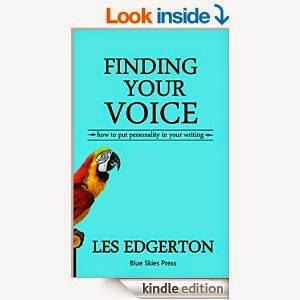
(If you're interested in finding your own voice a bit quicker, you might glom onto this one.)
Here’s where the crux of the problem lies, I believe.
That standard of good writing we’re trying to match is viewed incorrectly by us
and it takes time to learn this. We’re only paying attention to the outward voice
of the writer. And, this is where we keep falling down. We’re trying to mimic
that particular voice. And, that’s the one thing we should be avoiding. It’s
like a person who wants to be a TV broadcast journalist and his hero is Walter
Cronkite. Cronkite is his standard of excellence. This guy doesn’t realize that
we already have a Walter Cronkite and that no one is looking for a Cronkite,
Junior. Or, pick a contemporary broadcaster, doesn’t matter who. Virtually no
one in the audience wants a clone or twin of that person. But, we know that
that person is the standard of excellence. So what happens to all of these
bright-eyed wannabe broadcasters? Well, to many of them, the same thing happens
to the writer whose idea of a good writer is say William Faulkner. They begin
to imitate the “master.” And this is why it often takes years and years before
the gap between the standard and our own writing begins to narrow. We’re mostly
looking at the outward manifestation of their art. In the case of the
broadcaster, they begin to assume the personal tics of Cronkite. The speech
patterns he favors. The way he emphasizes certain words and parses his sentences.
His steely stare. Maybe even his haircut and suit choice. In the case of the
writer who holds Faulkner up as his standard of excellence, he or she might do
the same things. They look at the cadence of his sentence, the vocabulary
choices Faulkner makes, the syntax of his prose, etc. That person is looking at
the superficial aspects of Faulkner but never dig into the real thing that he’s
doing. They’re looking at superficial artifacts. We’ve all probably done that.
We look at the words on the page and think that if we can just learn to string
together similarly-sounding sentences we’ll have arrived. Alas, it does not and
cannot work that way. We need to instead be looking at the attitude, the
personal stance of the writer to his story, the emotions of the writer toward
his or her work. We need to focus on our own emotional stances toward what we
want to write. When we learn to do that, we begin to formulate our own voices
and when that day arrives, we will have become good writers. Warriors. You just
have to keep pushing through all that junk and one day it will happen. Our
writing will no longer be crap and we’ll have become… warriors.
And this is what I wish for everyone here.
I hope this gives you some food for thought and that you
find it helpful.
Don’t give up too soon.
Here are some other
things to consider:
- Have something worth saying.In his book Culture Care, artist Makoto Fujimura
tells a story he confesses may be legendary about a Yale student taking
Hebrew from the great Old Testament scholar Brevard Childs. The student,
discontent with his grades, asked the scholar how he could raise them.
Childs’s answer: “Become a deeper person.”
Peggy Noonan, writer of seven books
on politics, religion, and culture, and weekly columnist forThe Wall Street
Journal, at one time the speech
writer for the man considered The Great Communicator—Ronald Reagan. In her book
Simply Speaking, she says that what moves people in a speech is the
logic. The words “Tear down this wall, Mr. Gorbachev” are not all that poetic
when taken at face value. But they express something that resonates in the
human heart. In the words of Robert Frost, “Something is there that doesn’t
love a wall.”
In the same way that logic is what moves people in a speech, logic is what
moves people in writing. And to have logic, to move people, we must have
something worth saying. In fact, probably about 90% of writing is having
something worth saying. And how do we get something worth saying? By expanding
the world of ideas to which we expose ourselves and by cultivating a rich inner
life.
- Decrease your vision. That is, “think local.” Start with your family. Doug
Bender, the bestselling author of I Am Second: Real Stories. Changing
Lives. wrote a book for an audience of one. When Doug’s wife had a
miscarriage, it grieved the Bender’s little girl. So Doug wrote a child’s
book about death and loss just for her.
A seminary professor told his
students, “Stop thinking you will go out and save the world, and instead become
the best family member you can be, the most grateful child of your parents, the
greatest and most dependable encourager in your church, the best contributor to
your community.” We influence the world one small corner at a time. Cherish the
small.
In the days when Abraham’s
descendants had been carried off from Israel to Babylon, their prophet,
Jeremiah, sent a letter to King Nebuchadnezzar for the surviving leaders in
exile. Jeremiah’s counsel: “Build houses and settle down; plant gardens and eat
what they produce…. Seek the peace and prosperity of the city to which I have
carried you into exile” (Jere. 29:1–7). Seeking the good of the city where we
live is always good counsel. So write for your kids, if you have any.
Contribute good columns to the local paper. Donate some book reviews for your
favorite local web site. Do readings at the library. And do so simply to give
back and because you wish to make your corner of the world a better place.
- Write what contributes to human flourishing, not what
you perceive as the next hot market. Trying to predict what will
sell is like leaning on cobwebs. Just about the time you find a post to
rest against, it gives way. By the time you finish writing a book to meet
demand, the market will have left you in the dust. So write what you love
to write and/or what you can write with excellence.
- Measure success accurately. You will be tempted to measure your own success
by a number of externals that have nothing to do with your worth. Tell
yourself they are lies.
The only human-made structure
visible from space was not the Golden Gate Bridge or the Eiffel Tower or even
the tallest building in the world, but only the Great Wall of China. Think of
all the amazing structures that “failed” to make that list.
But that does not make these structures failures. It just means that when
measured by one narrow definition of success, they failed. As writers, any
number of false measures can make us feel like losers. Did our last book fail
to earn out its advance? Did we do a book tour? Did the work gain rave reviews
in Publishers Weekly and Library Journal? These are not accurate
measures of whether we can write. Lots of crummy books sell big. Many divergent
books make their authors lots of money, but that does not make the books or the
authors successes.
So measure not by money or fame, but
in influence on human flourishing. And of course, that is impossible to
measure. Which is precisely my point.
To sum
up: stay the course. Everybody goes through the period where what they create
doesn’t match up with their sense of what’s good writing. You simply have to
keep on working and eventually you’ll emerge and it will. This is the point
where we lose most writers. Don’t be one of those who quit just before they
attain the prize.
In
closing, let me quote the words of that immortal philosopher, Red Green, who
says: Keep your stick on the ice. We’re all in this together and I’m pulling
for you.
Thank
you.
Les Edgerton




 Posts
Posts


